
Podcast on YouTube
AI is disrupting the careers of mathematicians at universities! But even if you don't care about mathematicians losing jobs, this topic might be important for your career. So stay with me.
OpenAI broke the rules. The company solved over 300 advanced, long-standing math problems using ChatGPT. One of them is the Navier-Stokes problem, which was one of seven “Millennium Problems” selected by the Clay Mathematics Institute in the year 2000 as a way of tracking the progress of mathematics in the new millennium.
Mathematicians who have applied for research grants linked to these problems fear for their income.
Prof. Tristan Buckmaster from the New York University Department of Mathematics says: "Overnight, from three people I know personally, they destroyed their entire research program".
Why has OpenAI just broken the rules? The company built AI models and marketed them to the public, companies, and organizations. What it didn’t do before is solve research problems with its own tools on a major scale.
Senior mathematicians fear for their careers unless they have a tenured position at the university. They apply for research grants that pay their income for years to come. Unexpected career disruption!
You might say, why should I care? Shaking up stuffy academia might bring innovation faster and better. Maybe. But what OpenAI did was claim the problems were solved with little or no due diligence. Lack of quality control!
Unfortunately, academic quality control for writing and submitting a research paper to a peer-reviewed journal takes years. Years of research and writing, and years of peer review, and acceptance for publication. The peer-review process is critical for quality control.
Why would an intelligent person, a researcher, take it upon himself or herself to endure this year-long process? Typically not once, but several times. Two short answers.
First, they get funded for their research, which pays their salary.
Second, this is typically the career track that leads to becoming a tenured Professor at a university.
Without a tenured position, an academic researcher doesn't make enough money to live and makes too much to die. So researchers have to go for second income streams, such as teaching or doing some contract work at companies. This does not allow them to focus on research only. On the upside, it builds another skill set that might be essential in their career.
Did ChatGPT make use of research proposals?
Another critical concern is that OpenAI, with ChatGPT's help, might have used material from the researchers' grant applications. Some used ChatGPT to summarize their research proposal. OpenAI denies that. But on second thought, we should all be careful about what we feed a large language model. They are eager to learn and have quite a good memory. 😉
Creative process - Learning and positive unintended outcomes
When researchers work to achieve the goals of their research proposal, "unintended" outcomes are essential.
1. They personally learn a lot. That qualifies them to go from junior researcher to researcher to senior researcher to Professor. This is not just a career track, but a path for personal learning and development.
2. They might find a solution to a problem that they did not think about before, and maybe nobody else did.
Let's explore the unintended outcomes a bit. Prof. Giordano Scarciotti presented how Leonhard Euler, one of the greatest mathematicians of all time, researched an insignificant problem. We are in the year 1736 in Königsberg. A river, two islands, and seven bridges connected the different parts of the city. People wondered: can you take a walk about all seven bridges without crossing any bridge more than once? Would you have considered this question an important mathematical problem?
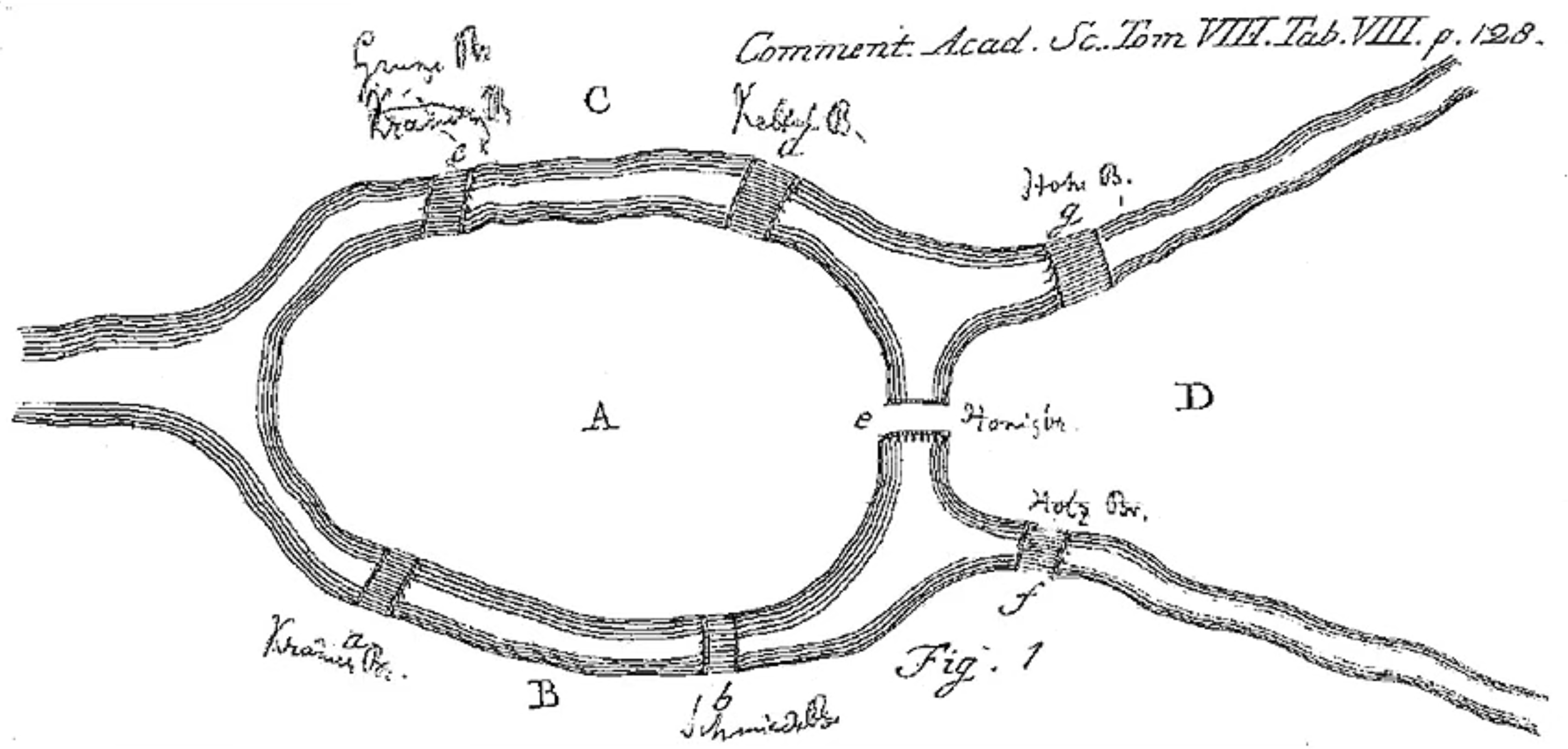
Königsberg Bridges – 1736
Euler's answer to the problem was: No! Did that have any practical use? No!
But on the way to solving the problem, he invented a new form of mathematics: Graph theory. Graph theory is fundamental to computer networks, internet routing, and logistics.
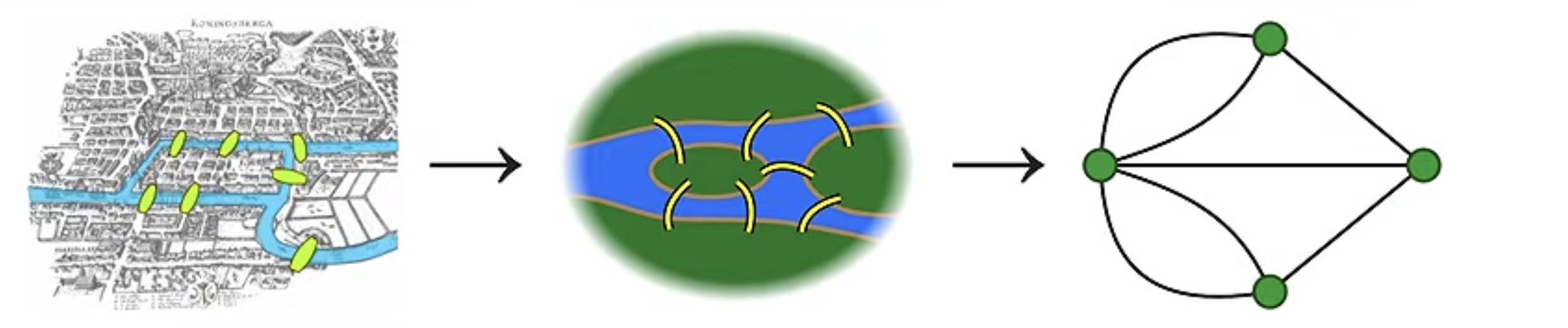
Applications of graph theory
When you pose this problem to an AI, the answer would be "no" or "cannot be solved". It is unlikely to develop graph theory along the way.
Career tracks and ecosystems
Let's return to the career issue. Careers do not happen in a vacuum. They happen within economic systems where people can earn an income. To a certain extent, careers are vertical. A person does not become a professor out of the blue. You study, do your PhD, do a Postdoc as a researcher, and when you do well and are a bit lucky, you get a tenured position as a professor.
Same thing in business. You don't just study, graduate with a master's degree, and become the CEO or CFO of a publicly listed company.
Is AI killing career ecosystems?
The example of mathematicians getting no grants might have a deeper impact. Let's assume you are a talented young person considering studying mathematics and pursuing a career in academia. You might have second thoughts when you just see what happened with OpenAI breaking the rules. To be fair, I don't think they wanted to kill the career ecosystem for mathematicians. Unintended consequences – collateral damage!
But the issue is not limited to mathematicians and universities. University graduates have been having difficulty finding entry-level jobs over the last two years. This is the case in the US, China, Germany, and so on. Part of this is caused by a slower economy.
Check out my blog article "Why Were They Booed by Graduates?" linked to that challenging situation.
If we don't create entry-level jobs for graduates and career leaders as part of a functioning career ecosystem, we will not have senior specialists, senior researchers, or qualified CEOs.
Thank you for reading.
Be meaningful and curious!
SOURCES
Chang, K., & Roberts, S. (Oct 6 2026). OpenAI Releases Findings on 377 Math Problems, Further Roiling Field. New York Times. https://www.nytimes.com/2026/10/06/science/openai-math-problems.html
MS NOW. (2026, Oct 11 2026). In ‘A chilling effect’: How OpenAI’s massive math breakthrough is ‘Destroying’ early careers. https://www.youtube.com/watch?v=a65dI2AYL3o
Scarciotti, G. (2026, Oct 9 2026). In You Truly Don't Understand What Just Happened to Mathematics. https://www.youtube.com/watch?v=KqiDqJMxg6o&t=2s
Singer, G. (Oct 30 2026). Why Were They Booed by Graduates? https://lifeandcareer.eu/blog1/why-were-they-booed-by-graduates
